 Add to Chrome
 Add to Firefox
 Add to Edge
UnityMAS-O: A General RL Optimization Framework for LLM-Based Multi-Agent Systems
May 26, 2026
LLM-based multi-agent systems decompose complex tasks into interacting roles, but most remain manually orchestrated by prompts, tools, and control rules, while agents are rarely optimized through a unified reinforcement learning interface. Existing RL post-training frameworks mainly target single-policy optimization and lack abstractions for user-defined multi-agent workflows, structured interaction, role-specific credit assignment, and configurable parameter sharing. We present UnityMAS-O, a general RL optimization framework for LLM-based multi-agent systems. UnityMAS-O treats the complete workflow as the optimization unit, rather than a single response or policy trajectory. It represents workflows through four first-class objects: logical agent roles, graph trajectories, user-defined rewards, and agent--model mappings. This decouples logical agents from physical model parameters, supporting full sharing, full separation, and partial sharing, with rewards assigned at role, turn, and trajectory levels. UnityMAS-O extends verl with a Ray-based star-topology runtime. A central controller executes workflows, invokes tools, records structured trajectories, and assembles rewards; model-local worker groups handle rollout, buffering, advantage computation, and distributed PPO-style updates. Users can define agents, workflows, model mappings, and rewards without rewriting the optimization infrastructure. We instantiate UnityMAS-O on retrieval-augmented QA, iterative agentic search, and reflective code generation. Across Natural Questions, HotpotQA, and held-out code tasks, multi-agent RL improves manually specified workflows after optimization, with especially large gains for smaller models and strict code all-passed metrics. These results show that UnityMAS-O can serve as a reusable substrate for converting diverse LLM-based multi-agent workflows into trainable multi-agent RL systems.

Tournament-GRPO: Group-Wise Tournament Rewards for Reinforcement Learning in Open-Ended Long-Form Generation
May 26, 2026Reinforcement learning in open-ended long-form generation is challenging because reliable reference answers and automatic metrics are often unavailable. Existing rubric-based methods typically rely on pointwise LLM-as-a-judge scoring, but absolute scores are difficult to calibrate across complex responses, may provide weak discrimination among same-query rollouts, and can become saturated during optimization. We propose Tournament-GRPO, a group-wise reward framework that converts rubric-guided LLM judgments into relative rewards through repeated multi-round tournaments among same-query rollouts. Tournament-GRPO compares candidates within groups, accumulates tournament outcomes, and normalizes them into group-wise rewards for GRPO training. Experiments on Deep Research Bench show that Tournament-GRPO consistently outperforms existing reward-design baselines, achieving a 4.52-point overall-score improvement over the strongest baseline. Further analyses show that tournament rewards provide a favorable effectiveness--efficiency trade-off and that tournament design affects training dynamics. These results suggest that rubric-guided tournament comparison provides an effective reward signal for reinforcement learning in open-ended long-form generation.
Knowledge-Graph Paths as Intermediate Supervision for Self-Evolving Search Agents
May 07, 2026Self-evolving search agents reduce reliance on human-written training questions by generating and solving their own search tasks. We build on Search Self-Play (SSP), a representative Proposer and Solver framework in which questions are generated and answered via multi-step search and reasoning. In practice, however, SSP faces two bottlenecks: the Proposer constructs questions from isolated answer entities without relational context, yielding many invalid or unverifiable questions in early self-play training, while the Solver receives only a binary outcome reward that discards useful signal from partially on-track search trajectories. We address both bottlenecks by reusing knowledge-graph paths as construction-derived intermediate supervision for both question construction and reward shaping. First, we ground question construction in LLM-guided knowledge-graph subgraphs, providing relational context for the Proposer. Second, we observe that constructing and solving a multi-hop question can involve overlapping intermediate entities: the factual bridges used to formulate the question may provide approximate waypoints for answering it. Exploiting this overlap, we introduce Waypoint Coverage Reward (WCR), which grants graded partial credit to incorrect Solver trajectories according to their coverage of entities on the construction path, while preserving full reward for correct answers. Across seven QA benchmarks and nine model configurations, our approach improves the average score over standard SSP in all configurations, including notable gains on multi-hop QA tasks. These results suggest that knowledge-graph paths can be reused as lightweight intermediate supervision, providing both relational guidance and process feedback without additional task-specific human annotations or manually labeled process steps.
PRAISE: Prefix-Based Rollout Reuse in Agentic Search Training
Apr 04, 2026In agentic search, large language models (LLMs) are trained to perform multi-turn retrieval and reasoning for complex tasks such as multi-hop question answering (QA). However, current search-based Reinforcement Learning (RL) methods suffer from two core limitations: expensive long-horizon rollouts are under-utilized during training, and supervision is typically available only at the final answer, resulting in severe reward sparsity. We present Prefix-based Rollout reuse for Agentic search with Intermediate Step rEwards (PRAISE), a framework for improving both data efficiency and credit assignment in agentic search training. Given a complete search trajectory, PRAISE extracts prefix states at different search turns, elicits intermediate answers from them, and uses these prefixes both to construct additional training trajectories and to derive step-level rewards from performance differences across prefixes. Our method uses a single shared model for both search policy learning and prefix answer evaluation, enabling joint optimization without extra human annotations or a separate reward model. Experiments on multi-hop QA benchmarks show that PRAISE consistently improves performance over strong baselines.
JADE: Bridging the Strategic-Operational Gap in Dynamic Agentic RAG
Jan 29, 2026The evolution of Retrieval-Augmented Generation (RAG) has shifted from static retrieval pipelines to dynamic, agentic workflows where a central planner orchestrates multi-turn reasoning. However, existing paradigms face a critical dichotomy: they either optimize modules jointly within rigid, fixed-graph architectures, or empower dynamic planning while treating executors as frozen, black-box tools. We identify that this \textit{decoupled optimization} creates a ``strategic-operational mismatch,'' where sophisticated planning strategies fail to materialize due to unadapted local executors, often leading to negative performance gains despite increased system complexity. In this paper, we propose \textbf{JADE} (\textbf{J}oint \textbf{A}gentic \textbf{D}ynamic \textbf{E}xecution), a unified framework for the joint optimization of planning and execution within dynamic, multi-turn workflows. By modeling the system as a cooperative multi-agent team unified under a single shared backbone, JADE enables end-to-end learning driven by outcome-based rewards. This approach facilitates \textit{co-adaptation}: the planner learns to operate within the capability boundaries of the executors, while the executors evolve to align with high-level strategic intent. Empirical results demonstrate that JADE transforms disjoint modules into a synergistic system, yielding remarkable performance improvements via joint optimization and enabling a flexible balance between efficiency and effectiveness through dynamic workflow orchestration.
Self-Compression of Chain-of-Thought via Multi-Agent Reinforcement Learning
Jan 29, 2026The inference overhead induced by redundant reasoning undermines the interactive experience and severely bottlenecks the deployment of Large Reasoning Models. Existing reinforcement learning (RL)-based solutions tackle this problem by coupling a length penalty with outcome-based rewards. This simplistic reward weighting struggles to reconcile brevity with accuracy, as enforcing brevity may compromise critical reasoning logic. In this work, we address this limitation by proposing a multi-agent RL framework that selectively penalizes redundant chunks, while preserving essential reasoning logic. Our framework, Self-Compression via MARL (SCMA), instantiates redundancy detection and evaluation through two specialized agents: \textbf{a Segmentation Agent} for decomposing the reasoning process into logical chunks, and \textbf{a Scoring Agent} for quantifying the significance of each chunk. The Segmentation and Scoring agents collaboratively define an importance-weighted length penalty during training, incentivizing \textbf{a Reasoning Agent} to prioritize essential logic without introducing inference overhead during deployment. Empirical evaluations across model scales demonstrate that SCMA reduces response length by 11.1\% to 39.0\% while boosting accuracy by 4.33\% to 10.02\%. Furthermore, ablation studies and qualitative analysis validate that the synergistic optimization within the MARL framework fosters emergent behaviors, yielding more powerful LRMs compared to vanilla RL paradigms.
Efficient Thought Space Exploration through Strategic Intervention
Nov 13, 2025While large language models (LLMs) demonstrate emerging reasoning capabilities, current inference-time expansion methods incur prohibitive computational costs by exhaustive sampling. Through analyzing decoding trajectories, we observe that most next-token predictions align well with the golden output, except for a few critical tokens that lead to deviations. Inspired by this phenomenon, we propose a novel Hint-Practice Reasoning (HPR) framework that operationalizes this insight through two synergistic components: 1) a hinter (powerful LLM) that provides probabilistic guidance at critical decision points, and 2) a practitioner (efficient smaller model) that executes major reasoning steps. The framework's core innovation lies in Distributional Inconsistency Reduction (DIR), a theoretically-grounded metric that dynamically identifies intervention points by quantifying the divergence between practitioner's reasoning trajectory and hinter's expected distribution in a tree-structured probabilistic space. Through iterative tree updates guided by DIR, HPR reweights promising reasoning paths while deprioritizing low-probability branches. Experiments across arithmetic and commonsense reasoning benchmarks demonstrate HPR's state-of-the-art efficiency-accuracy tradeoffs: it achieves comparable performance to self-consistency and MCTS baselines while decoding only 1/5 tokens, and outperforms existing methods by at most 5.1% absolute accuracy while maintaining similar or lower FLOPs.
AdaSwitch: Adaptive Switching between Small and Large Agents for Effective Cloud-Local Collaborative Learning
Oct 17, 2024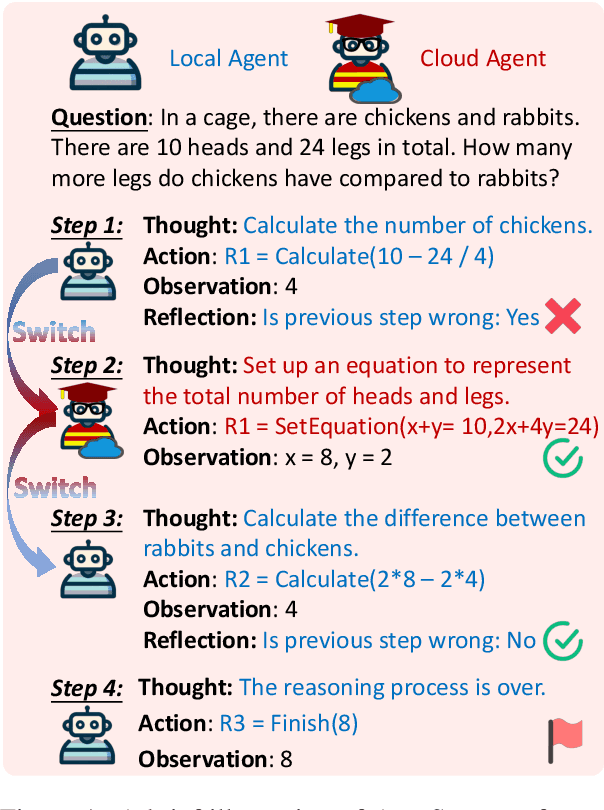

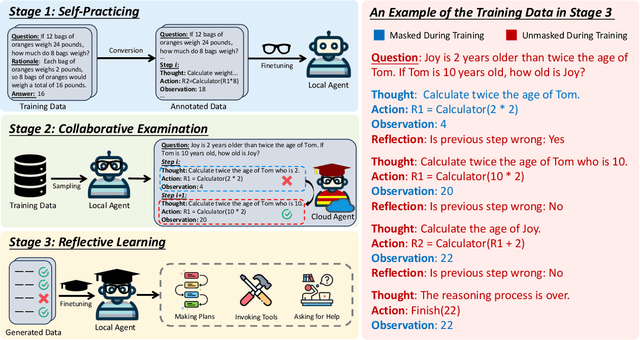

Recent advancements in large language models (LLMs) have been remarkable. Users face a choice between using cloud-based LLMs for generation quality and deploying local-based LLMs for lower computational cost. The former option is typically costly and inefficient, while the latter usually fails to deliver satisfactory performance for reasoning steps requiring deliberate thought processes. In this work, we propose a novel LLM utilization paradigm that facilitates the collaborative operation of large cloud-based LLMs and smaller local-deployed LLMs. Our framework comprises two primary modules: the local agent instantiated with a relatively smaller LLM, handling less complex reasoning steps, and the cloud agent equipped with a larger LLM, managing more intricate reasoning steps. This collaborative processing is enabled through an adaptive mechanism where the local agent introspectively identifies errors and proactively seeks assistance from the cloud agent, thereby effectively integrating the strengths of both locally-deployed and cloud-based LLMs, resulting in significant enhancements in task completion performance and efficiency. We evaluate AdaSwitch across 7 benchmarks, ranging from mathematical reasoning and complex question answering, using various types of LLMs to instantiate the local and cloud agents. The empirical results show that AdaSwitch effectively improves the performance of the local agent, and sometimes achieves competitive results compared to the cloud agent while utilizing much less computational overhead.
From Exploration to Mastery: Enabling LLMs to Master Tools via Self-Driven Interactions
Oct 10, 2024


Tool learning enables Large Language Models (LLMs) to interact with external environments by invoking tools, serving as an effective strategy to mitigate the limitations inherent in their pre-training data. In this process, tool documentation plays a crucial role by providing usage instructions for LLMs, thereby facilitating effective tool utilization. This paper concentrates on the critical challenge of bridging the comprehension gap between LLMs and external tools due to the inadequacies and inaccuracies inherent in existing human-centric tool documentation. We propose a novel framework, DRAFT, aimed at Dynamically Refining tool documentation through the Analysis of Feedback and Trails emanating from LLMs' interactions with external tools. This methodology pivots on an innovative trial-and-error approach, consisting of three distinct learning phases: experience gathering, learning from experience, and documentation rewriting, to iteratively enhance the tool documentation. This process is further optimized by implementing a diversity-promoting exploration strategy to ensure explorative diversity and a tool-adaptive termination mechanism to prevent overfitting while enhancing efficiency. Extensive experiments on multiple datasets demonstrate that DRAFT's iterative, feedback-based refinement significantly ameliorates documentation quality, fostering a deeper comprehension and more effective utilization of tools by LLMs. Notably, our analysis reveals that the tool documentation refined via our approach demonstrates robust cross-model generalization capabilities.
LLMs + Persona-Plug = Personalized LLMs
Sep 18, 2024
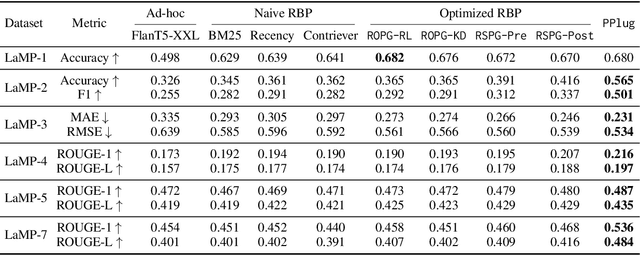


Personalization plays a critical role in numerous language tasks and applications, since users with the same requirements may prefer diverse outputs based on their individual interests. This has led to the development of various personalized approaches aimed at adapting large language models (LLMs) to generate customized outputs aligned with user preferences. Some of them involve fine-tuning a unique personalized LLM for each user, which is too expensive for widespread application. Alternative approaches introduce personalization information in a plug-and-play manner by retrieving the user's relevant historical texts as demonstrations. However, this retrieval-based strategy may break the continuity of the user history and fail to capture the user's overall styles and patterns, hence leading to sub-optimal performance. To address these challenges, we propose a novel personalized LLM model, \ours{}. It constructs a user-specific embedding for each individual by modeling all her historical contexts through a lightweight plug-in user embedder module. By attaching this embedding to the task input, LLMs can better understand and capture user habits and preferences, thereby producing more personalized outputs without tuning their own parameters. Extensive experiments on various tasks in the language model personalization (LaMP) benchmark demonstrate that the proposed model significantly outperforms existing personalized LLM approaches.